Engineering Background
Cylindrical capacitors are among the most widely deployed Capacitor forms in low-voltage industrial power systems. Their popularity is driven by mechanical robustness, favorable thermal performance, and ease of integration into standardized capacitor banks under IEC frameworks. Unlike prismatic or box-type designs, cylindrical capacitors are optimized for distributed installation in confined electrical enclosures.
Structural Design Characteristics
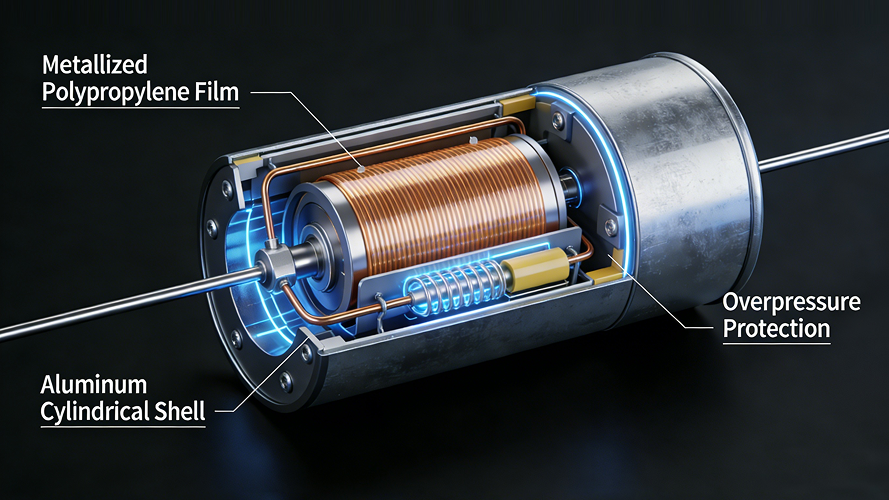
A cylindrical capacitor typically consists of metallized polypropylene film wound into a compact roll and housed within an aluminum or steel cylindrical enclosure. This geometry provides uniform electric field distribution and efficient heat dissipation across the capacitor surface.
Key structural features include: - Self-healing dielectric film - Internal overpressure disconnection mechanisms - Resin or oil-free dry impregnation
These features contribute to predictable aging behavior and enhanced operational safety in industrial environments.
Electrical Performance Considerations
From an electrical standpoint, cylindrical capacitors are designed primarily for fundamental frequency operation. Their rated voltage, capacitance tolerance, and thermal class are selected to match continuous duty under IEC utilization categories.
When deployed in capacitor banks, cylindrical units allow flexible step configuration and easy capacity expansion. However, harmonic exposure must be carefully evaluated, as standard cylindrical capacitors are not inherently designed for high harmonic current conditions unless paired with detuning Reactors.
Industrial Application Scenarios
Cylindrical capacitors are commonly applied in: - Automatic power factor correction panels - Motor control centers - Commercial building distribution boards - Renewable energy auxiliary systems
Their modular nature supports scalable system design and simplified maintenance practices.
Design Limitations
Despite their advantages, cylindrical capacitors are not universal solutions. In harmonic-intensive environments, their current-carrying limits may be exceeded without additional protective measures. IEC guidelines therefore recommend harmonic studies prior to installation.
FAQ
Are cylindrical capacitors suitable for outdoor installations?
Only when housed in appropriate enclosures with environmental protection.
Can cylindrical capacitors be used in detuned systems?
Yes, provided they are rated for the increased current caused by reactor interaction.

 English
 Español
 Portugues
 Pусский
 Français
 Deutsch
 日本語
日本語
 한국어
한국어
 العربية
 Italiano
 Nederlands
 Svenska
 Polski
 Türk dili
 हिन्दी
 Indonesia
 Melayu
 dansk
dansk
 Magyar
 қазақ
қазақ
 বাংলা
বাংলা
 עִברִית
 čeština
 українська
 беларускі
 Filipino
 Suomalainen
 اردو
اردو
 հայերեն
 български
 Hrvatski
 galego
 नेपाल
नेपाल
 euskara
 Shqipëria
 Malagasy
 Башҡорт
 Türkmenler
 Ilocano



 Ватсап
 Телефон
Комментарий
(0)